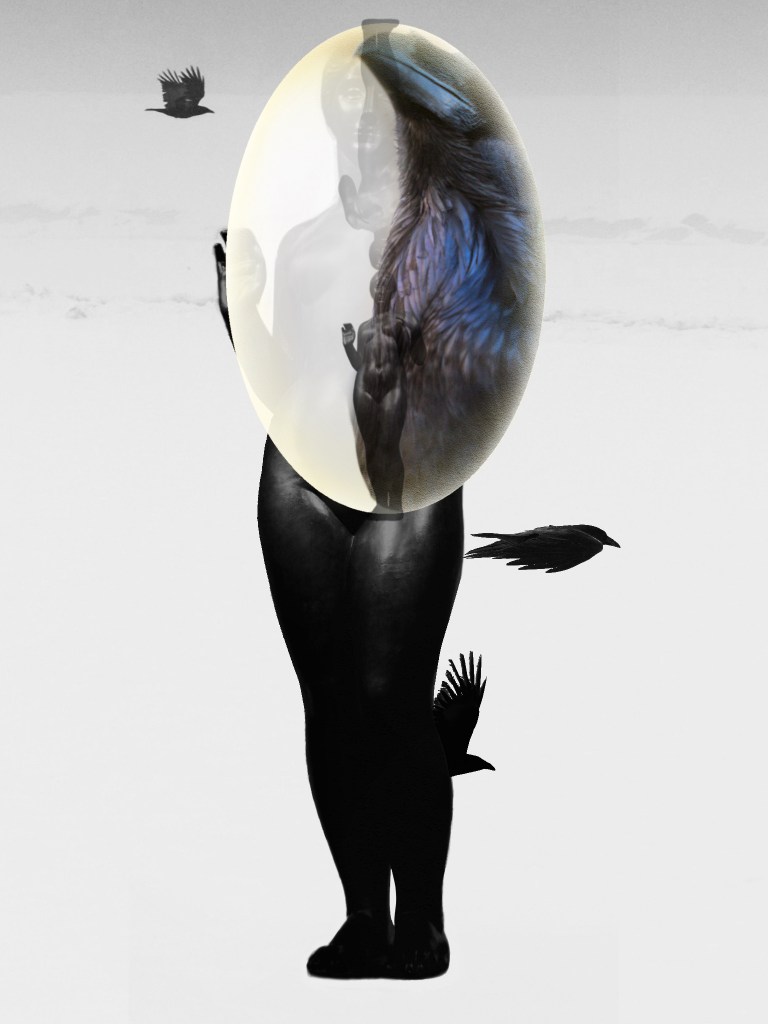
5.1.1.5 Raven – Faunian Omnivision
Once again Faunus lends its dual expression to yet another animal archetype. A being feathered in iridescent bluish black, to remind of an awareness that has reached into the void, bringing light out of the primordial darkness. Enfolding both the illuminating and the darkened aspect of the Sun, Faunus stands as a spaceholder for duality. At the Solar Eye Raven flies in the light of the dark Sun, the eye perceiving beyond duality, always remembering.
Ravens flare for tool-making and other mental activities like problem-solving and mimicking the sounds of other birds, beings and things, lends it a strange but magical air, while revealing several Faunian qualities. Raven crosses the border to other worlds, and moves freely in between. Raven will memorize the routes of the garbage truck, drop nuts on the road for cars to crack open and build its nest from human items thrown away. Raven plays within the space of alien worlds. Ravens have been observed calling wolves to an area to let them open the carcass of a dead animal to make it more accessible. Raven is thought to have the capacity to communicate about places and things that are distant in time and space. This all plays on the Faunian principle of extension, which can take on many different expressions.
With the stark duality of any Faunian archetype, Raven in some cultures are considered a bird of ill omen, overall evil, and capable of everything that is on the dark side of Faunus. In other cultures Raven is a trickster but also a creator god, bringing light to darkness. Within Norse myth the ravens Hugin and Munin, or ‘Thought’ and ‘Memory’, travel the ‘nine worlds’ to bring back what they have seen to the All-seeing god Odin. With Faunus all is remembered. Neither death nor rebirth is an obstacle. With this connection to the death-rebirth cycle, Raven’s image would often appear grim to the bystander watching Raven fly over the warriors in battle.
The image of ‘raven’ in the archaeological record
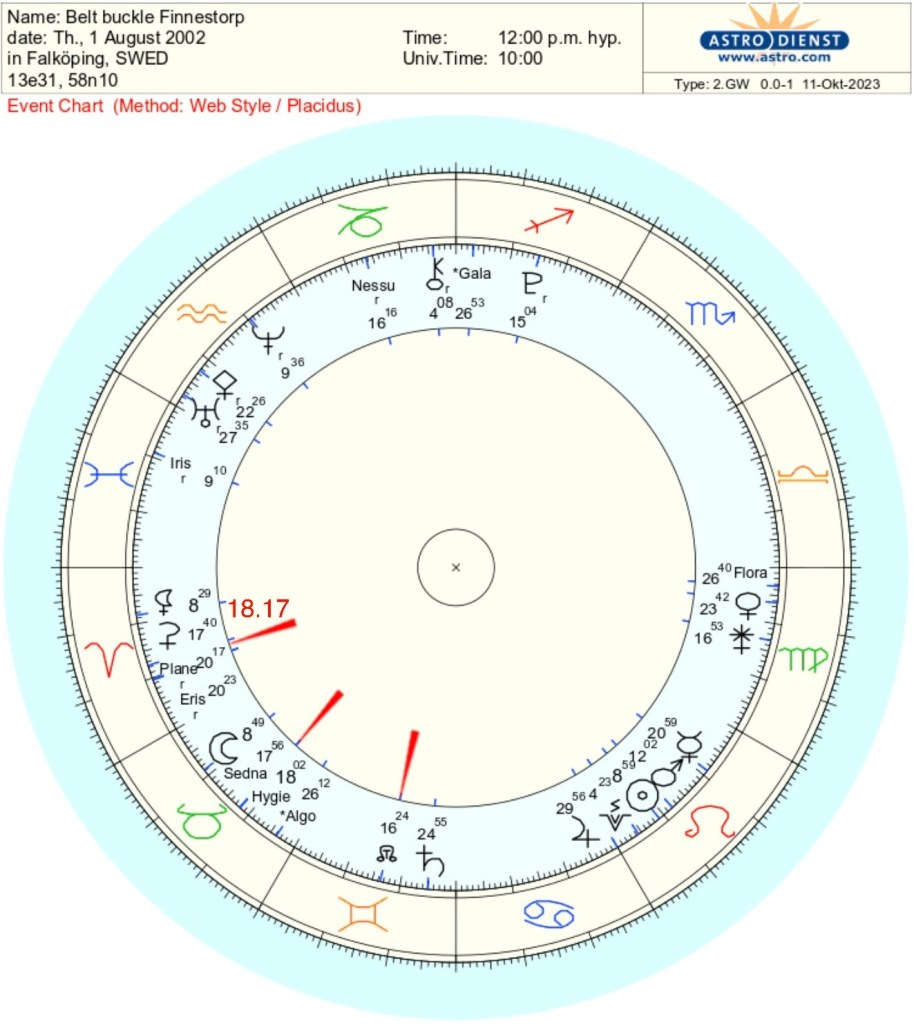
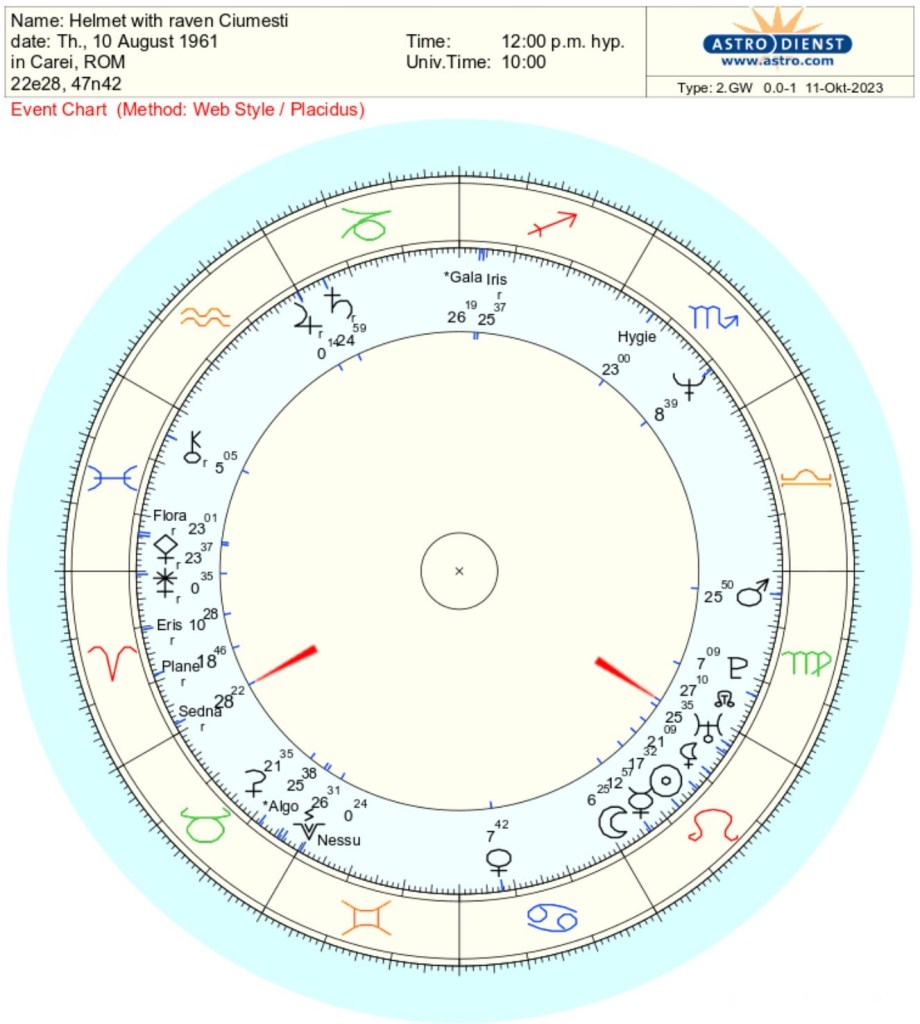
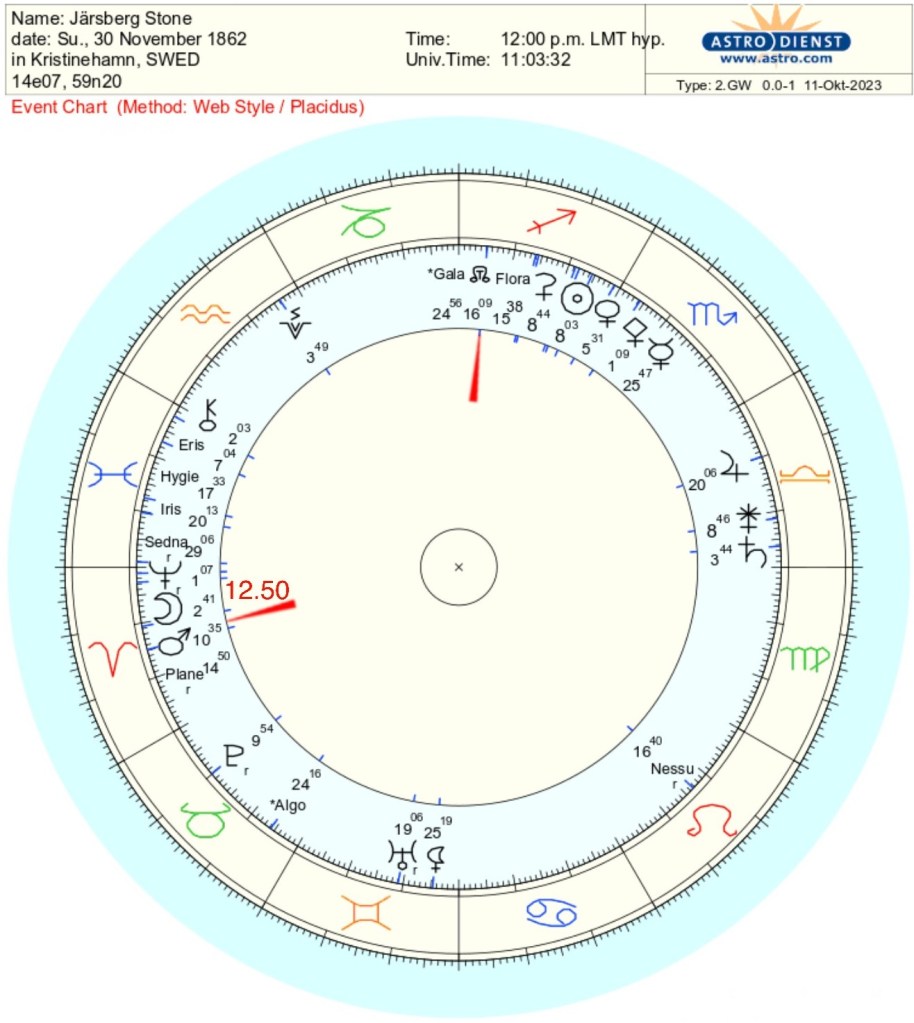
The astrological markers for the image of the raven are Faunus and Sedna, while Saturn would indicate the image of the crow.
Belt Buckle, Finnestorp
1 August 2002
This richly ornamented belt buckle, excavated at the site of Finnestorp, has been interpreted as depicting Odin at the well of Mimer with one of the details showing the two ravens Hugin and Munin reflected in the well.
Raven Helmet, Ciumesti
10 Augusti 1961
This helmet from the La Tene period, was found by a farmer in Ciumesti, Romania, while building a stable. It was found in a burial together with a chain armor and two brazen greaves. On the helmet sits the carefully crafted figure of a raven with a wingspan of 230 mm. The astrological chart has a Nessus-Sedna signature, a reflection of the image of a warrior as well as the image of the raven.
Järsberg Stone
30 November 1862
This stone was unearthed in Järsberg, Sweden, and is carved with a runic inscription. The one who carved the runes lets us know his name, Hrafn, which has the meaning raven. I considered adding this object to this study, although I am not sure that the name counts as an image that would reflect in the chart. The chart has a Faunus signature, which opens for the possibility of the name representing the animal archetype as well as a name.
Deviating objects
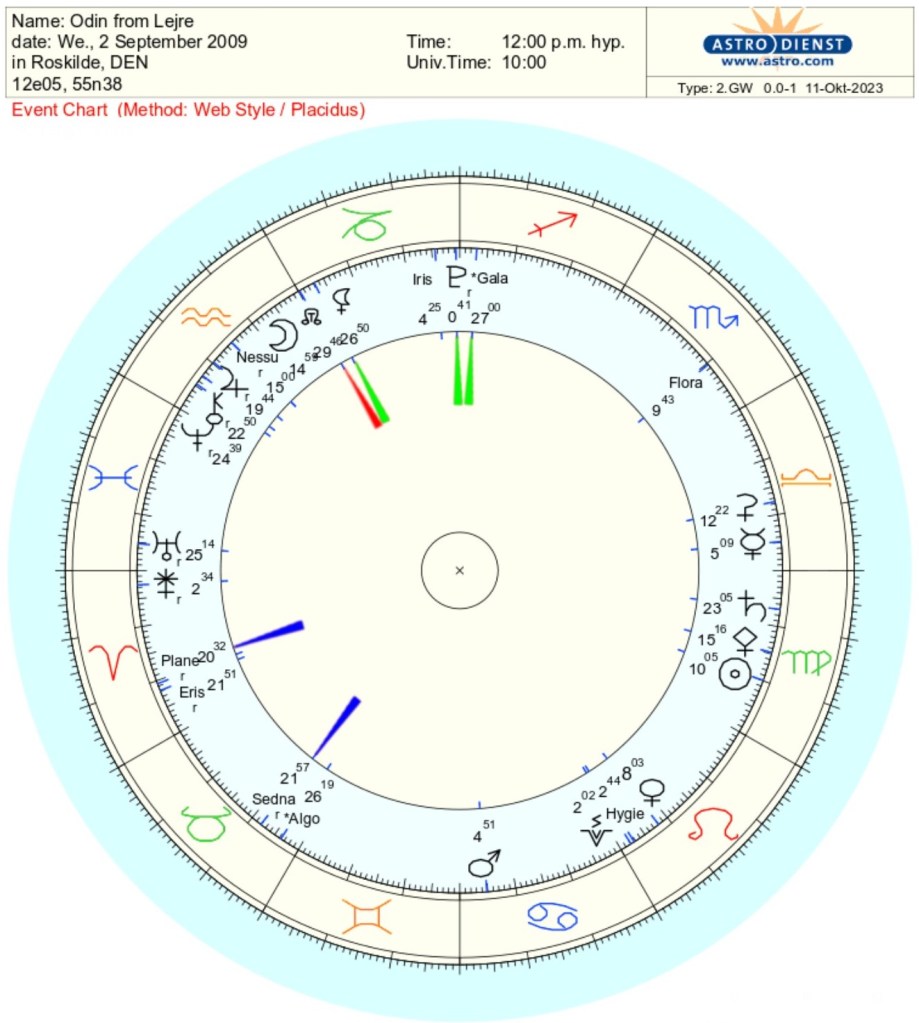
Oden from Lejre
2 September 2009
This small Viking age silver figurine was found during excavations in Lejre, Denmark. It is cast in silver with gilded details, and depicts a person seated on a throne with two animal heads at the top and two birds on the arms of the throne. Interpretations of what it represents differs. Some would say it is Odin on his throne Hlidskjalf, and the birds would be the ravens Hugin and Munin, while the animal heads are the wolves Gere and Freke. Others would point out that the figure is dressed in womens clothes and lacks male attributes. While I would not base an interpretation on the astrological chart, I do find value in studying possible reflections of the image in the chart. The astrological chart for the discovery of Odin from Lejre has a Black Moon-Pluto-Juno-Vesta-Galactic Center signature. I am not able to see a correspondence to what I would usually look for in the imagery of Odin or ravens, which is Faunus and Sedna. I do see a correspondence to the wolf and birds of prey in Pluto, but not to ravens specifically. The alignment to the Black Moon opens up to the possibility of this being a representation of a woman. The Black Moon usually would appear as a reflection of a goddess. The Black Moon also could represent birds in general, snakes and dragons and large cats. If this was Oden in female clothes during seidr, I would expect to see Sedna and Faunus in the chart.
10.10 Discovery Charts
Deviating Objects
Objects for further research and accession of dates of discovery;
Helmets and shield with raven ornament, Vendel (1881/1893)
 Belowthebridgeology