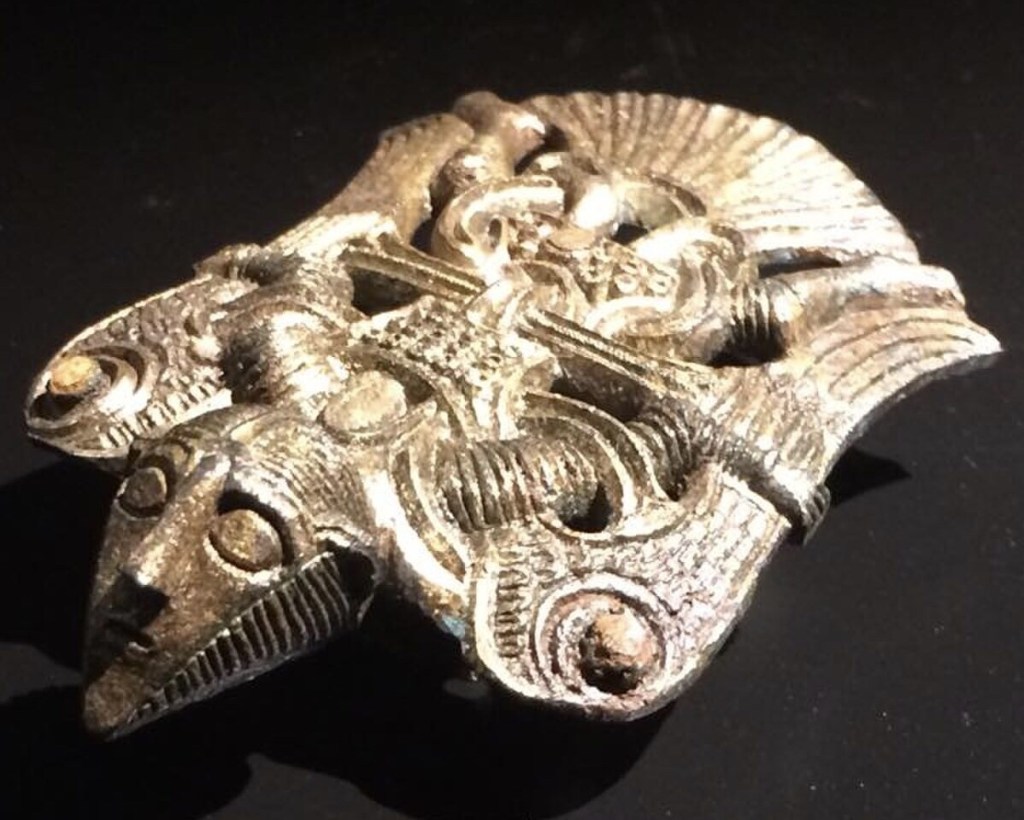
5.1.1.6 A Bronze Figure from Uppåkra and a Tale of Manmade Wings
Within the imagery of this gilded bronze fitting from Uppåkra, lies so many Faunian elements, it would serve as a type example of this planetary archetype. A man trapped on an island makes his own wings to escape. Or is it an act of shapeshifting, the soul taking on the form of a bird. Either way the manmade wings become a magical extension of the soul, a technology used to travel the landscape of consciousness. The shape-shifter has the power to change into an animal during trans-states or during sleep. Shape-shifting represents altered states of consciousness and a world interconnected, like islands in the sea, seemingly isolated but still an image of the boundlessness of Faunus.
The bronze figure from Uppåkra is thought to depict the master smith Völund. In the story of Völund as in many other stories of shapeshifting, the seemingly impossible feat of escaping an enemy is accomplished by taking on the form of an animal. The bronze figure from Uppåkra shows a man outstretched as if flying in his bird armor. The bird armor looks like a harness, and the man is gripping tightly to its wings, his legs spread out and fixed on each side of its tail feathers. Some would say the look is almost futuristic, as material extensions sometimes are viewed as such.
The story of Völund has been preserved in the poetic Edda and several other literary tales. It is a grim story of how Völund takes his revenge on his captor King Nidud. It is told that Völund was an elf chieftain, who together with his two brothers married three valkyries who came to them in the shape of swans. When the brothers after seven years were left by their wives, two of the brothers went to look for them while the third brother Völund stayed and took to forging rings for his wife, now gone. His work became widely known, and king Nidud set out to trap Völund to be his smith. Nidud put Völund on an island to work for him, and he cut off his hamstrings to ensure that he would not escape. Völund planned his revenge, and when the children of king Nidud came to visit he killed them and made drinking bowls from their skulls, jewelry from their eyes and a necklace from their teeth, which he sent to the king, his wife and his daughter. He then forged his bird armor and escaped the island.
During a shapeshifting any wounds to the animal body will later correspond to wounds in the human body. In the bronze figure from Uppåkra, what could be interpreted as four drops of blood, sits on the left wing of the bird shape. While there have been other possible interpretations of the figure, the careful detail of the four drops of blood makes the connection to the story of Völund all the more likely. The drops of blood could be said to originate from one version of the story of Völund, where his brother Egil is ordered by Nidud to shoot at Völund as he flies away. The arrow hits below his left hand as depicted in the bronze figure from Uppåkra1.
The image of the ‘Völund’ in the archaeological record
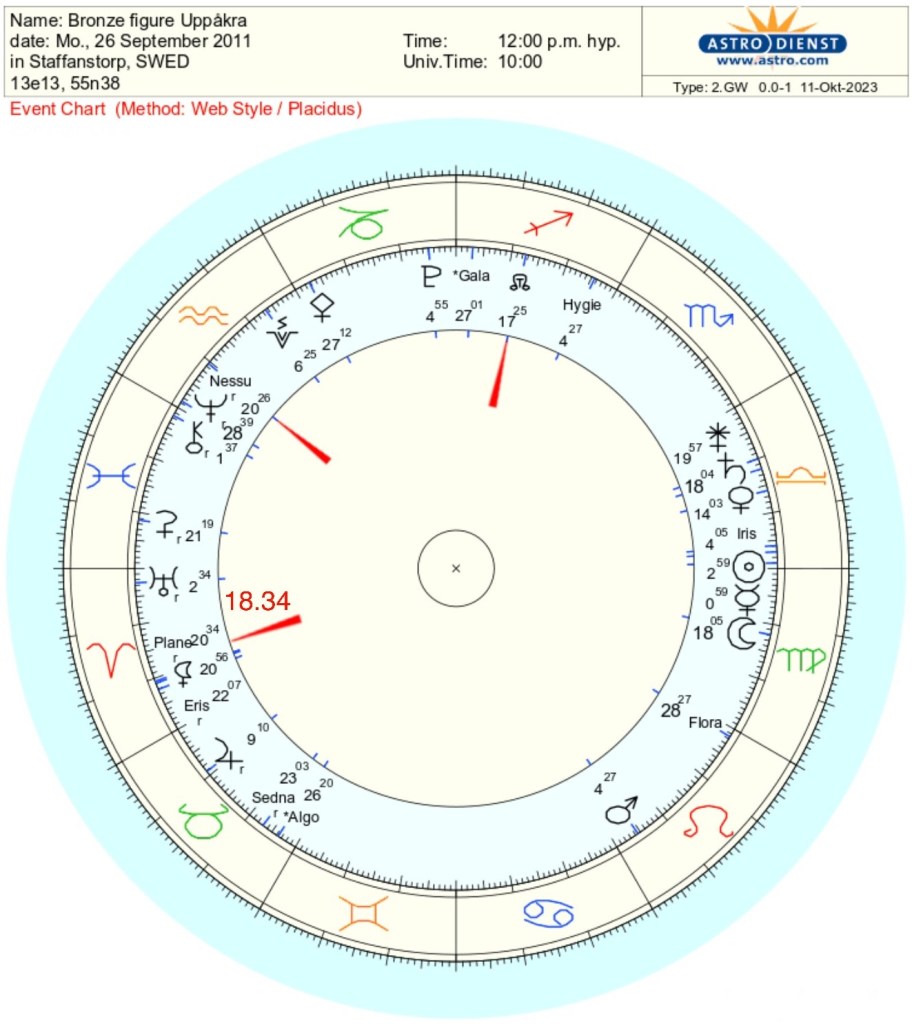
Bronze figure, Uppåkra
26 September 2011
The bronze figure from Uppåkra depicting a man in bird attire has been interpreted as Völund the smith in the wings he made to make his escape. Another interpretation suggests that it shows a god wearing the magical falcon cloak of Freya. On the background of the astrological chart, both would be possible. The prevailing interpretation seems to be that the figure represents Völund.
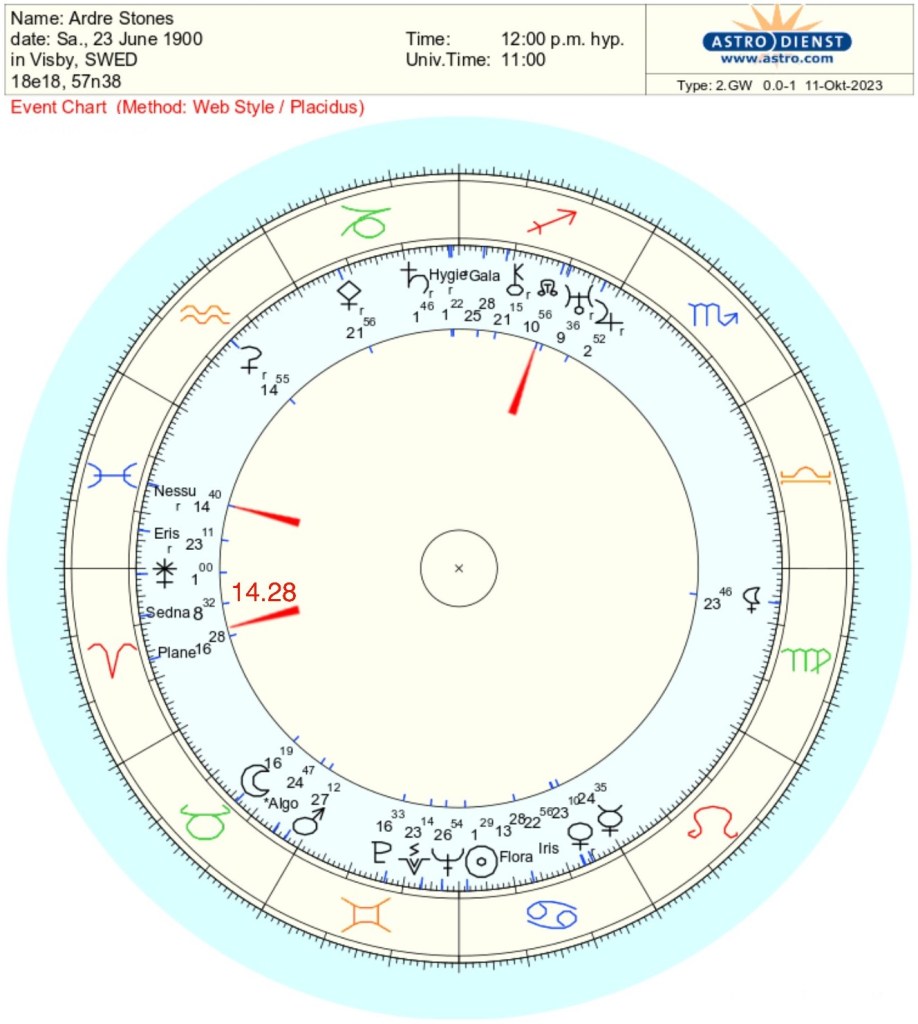
Ardre Stones
Ca 23 June 1900
Among the stones found in the floor of Ardre Church during a restoration were one stone carved with motifs from Norse mythology. Many different scenes are depicted, among which is Völunds escape from the captivity of Nidud. The date of discovery is not fully clear, but the Faunus-Nessus signature of the astrological chart is present from March to June the year 1900.
Reference
1. Vilma Berglund (2020). Spåren av Nordisk Mytologi i Uppåkra.
Image
Bronze figure, find from Uppåkra. Photo; Hedning (2014). Source; wikimedia commons
 Belowthebridgeology