5.1.1.3 The Villa of the Mysteries – Entering the Mysteries via Organic Faunian Technology and the Red-Blue Spectrum
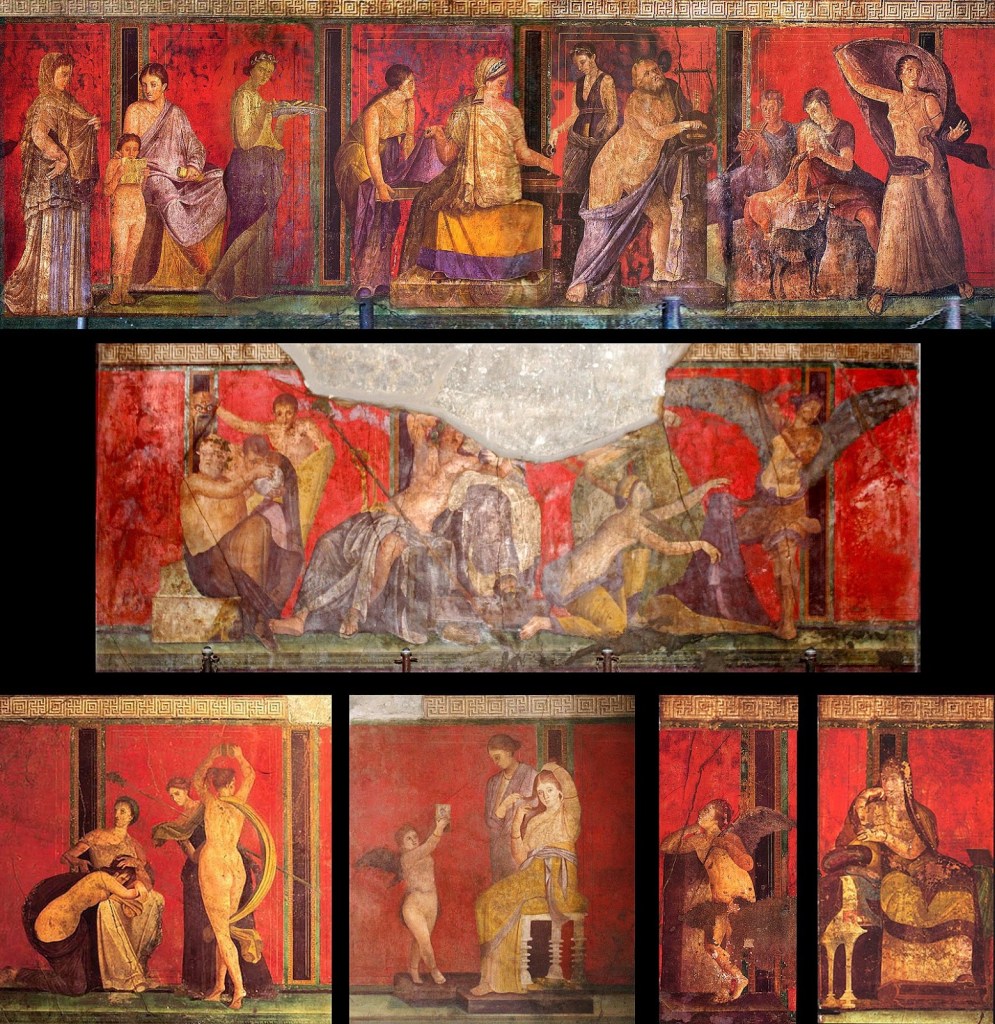
Once buried by the eruption of Vesuvius, the Villa of the Mysteries was found during excavations outside the town walls of Pompeii. This Roman villa stores well preserved frescos with a theme that allows us to explore some of the many emanations of Faunus and the Lunar Nodes, together conveying forms for a communion between body, Soul and Spirit. The imagery invites one to ponder the entanglement of these two astrological symbols within the context of the frescos. With Faunus representing the unbodied Spirit and the Lunar Nodes representing embodiment and Soul we have an enmeshment that begs for reverence, here presumably in the form of rituals surrounding a mystery tradition.
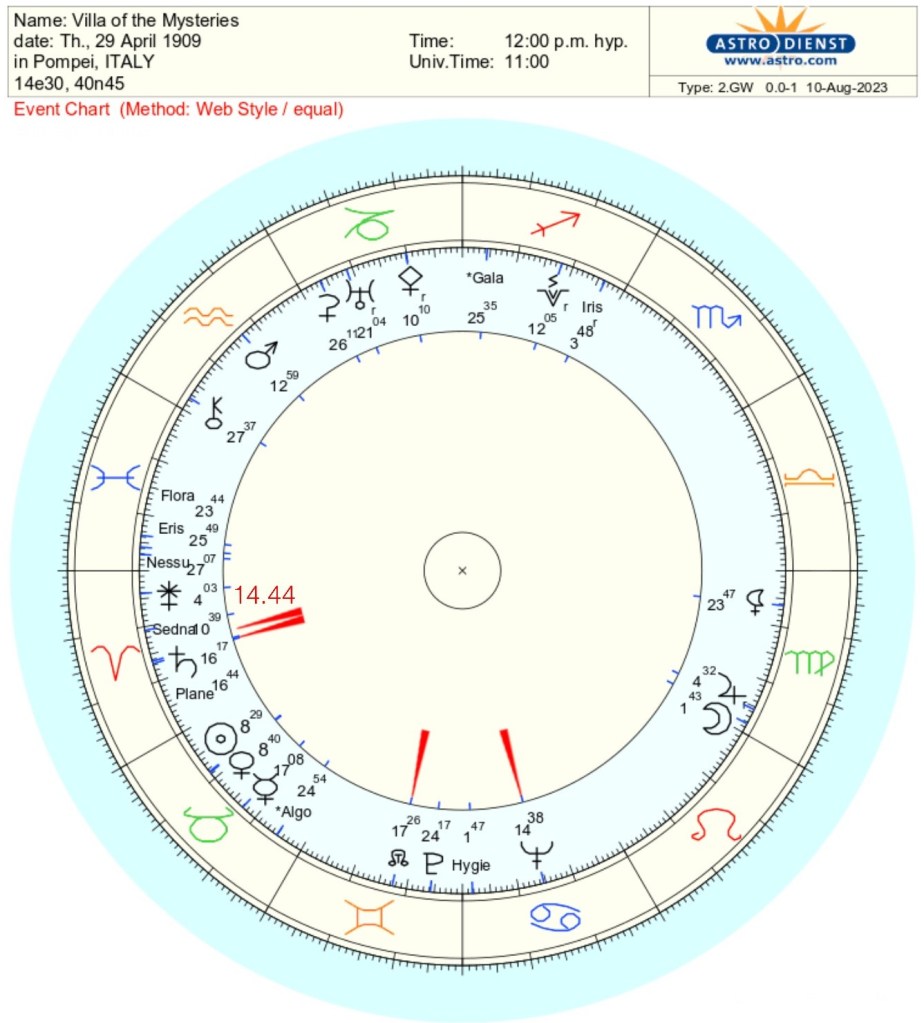
The chart of the discovery of the frescos has a Faunus-Neptune-Saturn-Uranus signature, with Saturn signaling the possibility of a theme connected to the Lunar Nodes themselves. Besides being an indicator of imagery pertaining to the Lunar Nodes, Saturn could also in itself signify imagery depicting forms for a ritual. Saturn would then represent that which gives structure to the mysteries, and that which is meant to create a safe space for a ritual proceeding, possible only through Saturnian commitment.
While the interpretations of the imagery within the frescos have not been uniform, on the background of the astrological chart, there is reason to align the interpretation with the more mystical comprehension. The frescos having esoteric and ritual elements are also the more widely accepted interpretation. What has been proposed by the scholars is that each fresco has a theme drawn from the Dionysian myth and mystery tradition, with a ritual sequence embedded within the imagery. The imagery is said to store esoteric knowledge connected to an initiation into the Dionysian mysteries, with each and every element holding some symbolic meaning. While some interpretations suggest that the frescos show the initiation of a bride, the astrological chart shows no clear indication of this unless we consider it a spiritual marriage.
The fresco shows in total 30 figures, of which 14 are considered human, taking part in ritual activities, and 16 of the figures are supernatural or animal taken from the Dionysian myth. One will notice that all the human figures, officiating and taking part in the ritual, are women, while almost all of the mythical figures are male. The only possibly non-mythological male is a young boy-child reading from a scroll.
Although there is some evidence for women-only groups practicing the rites of Dionysus I will stay open to an ambiguous meaning to the female dominance among the human figures within the imagery. When viewed from a purely symbolic perspective the image of male and female could take on a hidden layer of meaning. The female would then be the image of embodied Soul and the male would be the image of disembodied Spirit and Deity. The frescoes would then tell the story of the Soul being wedded to Spirit or, within the context of a Dionysian initiatory ritual, temporarily possessed by Deity.
The interplay between the bodily and the spiritual could also be said to be reflected in the color scheme of the frescos. With the cinnabar red color of the background one is pulled into the red of the lowest frequency of the physical realm, while the color purple, another color dominating the imagery, blends the physical with the spiritual. In my astrological study of poetry and song lyrics I have found both ’blue’ and ’red’ to be signified by Faunus and Sedna, being on the opposite ends of the color spectrum denoting a dualization, and coming together in shades of purple, sometimes representing the mystical field of spirit the forms in between the two poles.
Certain image elements in the frescoes have brought attention to the possible use of entheogens within the mystery rites. The mushroom shapes incorporated into the furniture design in the imagery, has been suggested to point towards its use as a catalyst in the ritual process. In the astrological chart this is reflected in the alignment to both Faunus and Neptune. While Fungi as a totem carries the transcendental essence of Faunus, Neptune could be telling of the use of intoxicants and plant medicine to induce an altered state of consciousness. Another Neptunian theme visible in the frescoes are the musical instruments shown in the imagery, indicative of music having a role in the ritual proceeding.
Perhaps this is not the place for me to judge the ritual traditions of the ancients, but during this study I have been drawn to ponder the implications of taking the short route into the Faunian field of the Dark Sun/Sun circuit, which can be seen in the microcosmic map. Despite the female theme of the imagery, I wonder if this kind of ritual pathwork is leaving out a feminine element, bypassing the Heart center, opening oneself directly to the field of Faunus through the use of psychoactive substances. It will effectively cue you into the sphere held between the Root center and the Third Eye, but I will leave it open for further revelation whether it also engages the Heart and Crown center. The field of Faunus is dualistic in nature, and demands to be approached as such, hence the need for the sanctity of dedicated ritual indicated in the frescos.
The field of Faunus represents the ‘All-seeing’, and if one looks closely at the frescoes, the gaze seems to play an important role in the image narrative. Even the goat, which of itself is a Faunian archetype, seems to become the vessel for Deity looking into the world. The world becomes the mirror, represented by the Lunar Nodes, and the mirror is a recurring element in the imagery of the frescos. Some would equate the reflections of the mirror to the distractions of worldly matter that pulls the Soul from its sense of unity. The seated bride looks away from the mirror, suggesting an awareness centered around something more than the worldly. The varied depictions of the gaze within the frescoes seem to tell a story all on its own, sometimes interacting with the observer. There is the gaze of the Self being fully present, represented by the Lunar Nodes, with the women looking towards each other during the different phases of the ritual or supposedly during this narrative of the Soul. And then there is the Faunian gaze making us aware of the presence of the All-seeing.
Fungi imagery in the archaeological record
The astrological markers for the image of ‘fungi’ are Faunus, Sedna and Black Moon.
Villa of the Mysteries
29 April 1909
The frescos were found within two weeks of breaking ground.
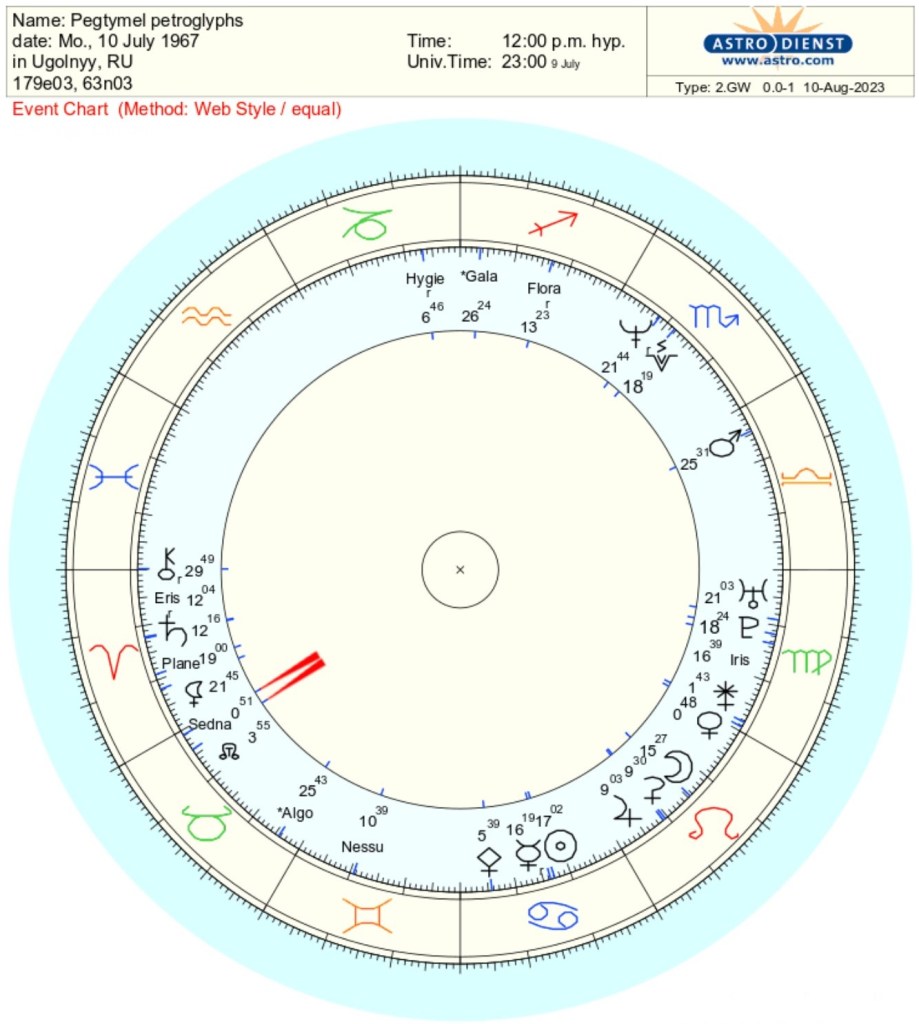
Pegtymel petroglyphs
10 July 1967
The rock art at the river of Pegtymel in Siberia, Russia, shows mushroom-headed figures that are likely a representation of the shamanic relationship with the hallucinogenic mushroom, probably Amanita muscaria. The first examination of the site was done in July 1967.
Deviating objects
–
Reference
- Peter Mark Adams (2019). Mystai: Dancing out the Mysteries of Dionysus
Images
Frescoes from the Villa of the Mysteries in Pompeii, Italy. Image; user:shakko (2019) Source; wikimedia commons
10.8 Villa of the Mysteries and Fungi
Objects for further research and accession of dates of discovery;
Selva Pascuala Rock Art (1917/1918)
Tassili n’Ajjer Rock art (1933?)
Inka Uyu mushroom stones (1950)
Ninnion Tablet (1895)
 Belowthebridgeology